China Sourcing Report (April 26): Navigating the New "Supply Chain Security" Regime
Analysis of China's new Supply Chain Security Regulations effective April 2026. How foreign buyers should adapt their sourcing logic to ensure stability and compliance.
4/27/20262 min read
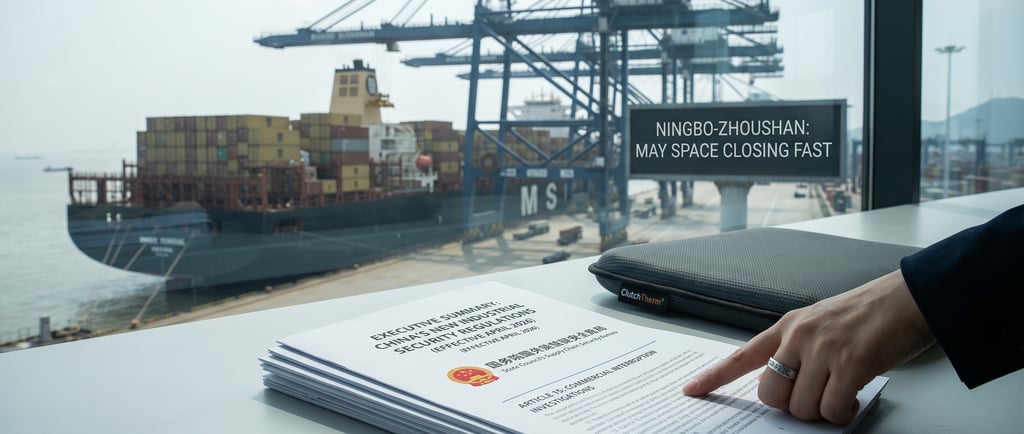
As we approach the final days of April 2026, the landscape for international procurement has fundamentally shifted. Beyond the physical products at the trade fairs, a new regulatory framework—the Regulations on Industrial and Supply Chain Security—is now the primary variable in your sourcing equation.
1. The Regulatory Logic: Stability as a National Asset
China’s State Council recently promulgated a unified regulatory framework for supply chain oversight. For the rational buyer, this represents a double-edged sword.
The Protective Side: The policy aims to prevent "discriminatory interruptions" and ensure the flow of critical goods. For stable, long-term partners, this reinforces the reliability of Chinese industrial clusters.
The Compliance Risk: Article 15 of the new provisions allows for investigations into commercial conduct that could be viewed as "interrupting normal transactions."
The Takeaway: In 2026, "de-risking" by abruptly cutting off Chinese suppliers is no longer just a business decision—it’s a legal gamble. Ensure your exit strategies or vendor transitions are handled with high-level legal transparency to avoid being flagged for "substantial harm" to chain security.
2. Canton Fair Phase 3: The "Last Mile" of Q2 Logistics
With Phase 3 (Textiles, Office Supplies, and Personal Care) starting on May 1st, the logistics window for Q3 "Back-to-School" inventory is closing fast.
The Shipping Reality: Ocean freight rates are experiencing a seasonal spike. Major carriers like MSC are reshuffling Asia-to-US West Coast rotations this week to manage congestion in Ningbo and Shanghai.
The Strategy: If your goods are ready, do not wait for the post-Canton Fair rush. Book your space by April 30th to avoid the emergency fuel surcharges triggered by recent volatility in the Strait of Hormuz.
3. Financial Logic: Beyond the Landed Cost
Many buyers focus on the "Price per Unit." A Munger-style analysis focuses on the "Cost of Systemic Failure."
The Math: If a $5.00 item has a 10% chance of a 30-day delay due to regulatory or logistics friction, its "Logical Cost" is significantly higher than a $5.50 item with a vertically integrated, compliant supplier.
The Recommendation: Prioritize suppliers who have already conducted internal audits against the new Supply Chain Security Regulations. A compliant supplier is your best insurance policy against government-level trade friction.
Expert Insight: "A great business at a fair price is superior to a fair business at a great price." In sourcing, a compliant, digitally-integrated supplier at a 5% premium is a bargain compared to the "unreliable" alternative.